Friday, October 14, 2011

Arctic First-Timer

Hey everyone! My name is Rachel Bobby and I’m an undergraduate chemistry major at Villanova University. This fall I am in my junior year at Villanova, but I met Dr. Grannas as a college freshman. After having her for a professor in my first analytical course, I learned that she was involved in environmental research. I thought this was pretty cool, so the summer after my sophomore year I began doing research in her lab.

When Dr. Grannas first asked if I wanted to venture into Alaska to continue my summer research, I thought, "Awesome! The arctic! I’ve never been there!" I was so excited to have a new experience and possibly even get to see some new culture. I had the stereotypical presumptions about what Alaska would be like: snow, glaciers, polar bears, and Eskimos. Boy, was I wrong.

Soon after I agreed to go on this trip, I learned that I wouldn’t be traveling to a common tourist city (Anchorage, Fairbanks...) but that I’d be spending a week in Barrow, Alaska. For those of you who aren’t familiar with Barrow, it’s about as far North as you can get, without actually being in the Arctic Ocean. Needless to say, I became a little less enthused at this thought, but still agreed to go.


When we arrived at the Barrow, Alaska airport I was immediately in shock. One – it was about 30° colder than Philadelphia at this time of year, and two- the airport was a single room consisting of a baggage claim belt, a metal detector/security station, and a few rows of chairs. Where had I landed that didn’t even have a proper airport!? At first glance, the town of Barrow seemed just as small and sparse, with wooden houses, metal "huts", a single grocery store, and a handful of restaurants. Little did I know that by the end of the week Barrow would grow on me.


Many people who visit Barrow might have the same thoughts and judgments that I first had on my arrival. A small, dreary town that was covered in snow and ice would not seem appealing to some. However, Barrow has its own kind of charm. The people living in this community rely on each other and help one another out in a way that most “down south” have forgotten how to do. This small town of about 4,000 people collectively contributes to each family’s food supply and general well being, ensuring that all will make it through the tough Alaskan winters with enough to eat and neighbors who truly care. When a crew catches a whale in Barrow, the meat is divided up evenly and distributed to each family. Never before had I experienced such a sense of community.


With respect to the town itself, Barrow has many hidden treasures that I was not anticipating to find. Restaurants like Pepe’s North of the Border serves awesome Mexican food… as well as Italian, American, and probably whatever else you are craving! The restaurant itself is a little Mexican oasis – yellow, red, and green decorations cover the walls and sombreros hang from the ceiling, and after eating there for the first time you receive your official "Arctic Circle Club: North of the Border" certificate. Osaka, a Japanese restaurant, serves some of the best sushi I have ever tasted, and a trip to the AC grocery store put in perspective for me how outrageous a simple gallon of milk is in Alaska - $10. Wow.


My trip to Barrow is an experience that I will never forget. The welcoming community and the Eskimo culture definitely broadened my horizons and made me step outside the small world of Villanova’s campus. I can honestly say that I was pleasantly surprised by this small Alaskan town and hope in the future that my research will bring me back again! :)

Wednesday, October 12, 2011

Back to Barrow

Hi again everyone! It has been a while, but we are back in Barrow!

We (myself and an undergraduate student, Rachel) arrived on Saturday evening. As I turned my phone on after we got off the plane (yes, we get cell phone reception up here) I received a text from a friend saying that two whales were caught that day ... one by our good friend (and logistics support manager from 2008 and 2009) Lewis Brower's whaling crew. Needless to say, I was quite happy to hear this. We quickly headed for the beach...Not to sunbathe, but to watch them bring in the whale. It took quite the effort to bring the 41 ft behemoth up onto land. It took a bulldozer and a loader to get the job done. But it finally made it, and the crew and community got to work cutting and dividing the shares.


Whaling is an integral part of life in Barrow, as most community members rely on subsistence living practices to survive. Steaks from the grocery store are not part of day to day living around here ... but whale steaks are quite tasty! There are two whaling seasons each year, and the International Whaling Commission sets quotas for each community that cannot be exceeded. This fall season, Barrow is allowed 13 "strikes". So they can bring in a maximum of 13 whales. However, a whale that is harpooned but lost also counts as a "strike". Because of the careful hunting practices and consideration of population dynamics, the arctic whale population is thriving and this subsistence hunting practice is in no way curtailing the whale population.

The whale caught by Lewis Brower's crew was harpooned around 1 pm and was then towed back to the beach from 24 miles out. This took several hours. By 9 pm it was up on solid ground and completely divided up by 4 am. Shares go to each member of the crew, as well as to those who help cut it up. The rest goes back to the whaling captain's home, where many hours are spent the following day cutting up the various pieces into what will be distributed to the community. Rachel and I went to Lewis' house on Sunday to help with this. We worked on cutting muktuk (the blubber with skin attached) and also some of the internal organs (heart, kidneys, etc). Below is Rachel working on this ...


We are here in Barrow for several reasons this time around. 1.) I will be giving a talk to the local community updating them on our research and "reporting back" our results to the local community. 2.) Philadelphia area high school teacher, Dr. Bill Smith, is also here (he arrived on Monday) to do "remote" classes to his students back at Bristol Borough High School. He started the first of these today and will continue these on Thursday and Friday. 3.) We are sampling snow to isolate natural organic matter which we will take back to our Villanova lab to characterize, which means filtering lots of snow. As I type this blog, Rachel and I are babysitting our filters. Ah, the joys of science!


Rachel plans to post something tomorrow on her first "Arctic experience", so stay tuned for that!

Saturday, August 13, 2011

Long Overdue Update

In case anyone is still keeping track ... it has been a while since we have had an update on the blog ... mainly because our major fieldwork efforts concluded in 2009. But, a few of our goals have been realized from a science standpoint ... a few papers have been published based on our fieldwork, and three more are currently in review. We also gathered a wealth of information that is now serving as the basis for continuing lab experiments and student thesis projects.

For those science geeks out there like us ... here are the citations for our published work based on Barrow fieldwork results:

Photochemical processing of aldrin and dieldrin in frozen aqueous solutions under Arctic field conditions. GA Rowland, AR Bausch, and AM Grannas. Environmental Pollution, 159, 1076-1084, 2011.

A solid-phase chemical actinometer film for measurement of solar UV penetration into snowpack. GA Rowland and AM Grannas. Cold Regions Science and Technology, 66, 75-83, 2011.

We'll have a few more updates coming this fall ... I (Dr. G) will be returning to Barrow in October to do some outreach/service work, accompanied by a Philadelphia area high school teacher as well as an undergraduate research student. We will be there about a week, and plan to post updates and info here on the blog.

Thanks for keeping tabs on us!

Friday, May 14, 2010

New Group Website

Hi all ...

Just a quick update - for anyone who might be interested, we have migrated our Villanova Research Group website to Google. Although I certainly love Villanova, they don't make managing your website an easy matter ... so I took things into my own hands and simply moved to a place that does!

Check us out at:

http://sites.google.com/site/amandagrannas

We'll be updating the site quite a bit over the next few weeks, including new pics (our group pic is a bit old) and videos. We will be making videos using a great tool I was introduced to called Animoto! Check out the inaugural video on the Welcome page!

Happy blogging!

Sunday, January 17, 2010

In the Spotlight

Well, since we're not in the field at the moment, updates are few and far between. But, please take the time to check out another site: www.arcticstories.net. The site is being developed by Peter Lourie (an author and storyteller extraordinaire) and contains all sorts of information, videos, pics, stories and science related to the Arctic.

If you click on the "videos" link, there are a number of videos from people who live and do research in the Arctic ... from Inupiaq hunters, to wildlife biologists, to atmospheric scientists. Not to self-promote ... but I'm in there too, under the science link. :)

We continue chugging away at sample analysis and are (almost) done with that, at which point I'll get another update posted asap. So in the meantime, peruse the Arctic stories at www.arcticstories.net.

Sunday, July 5, 2009

Barrow Fieldwork Photos

Everyone is back from Barrow now ... back in the lab, busily processing samples and analyzing data taken in the field. I've managed to compile a lot of pictures taken by the team into a slideshow. Check it out at the youtube link below!!!

Most of the photos were taken by Chun-mei Chiu and Simon Filhol. A few others were contributed by Glenn Rowland and me ... Thanks everyone for sharing your pics and letting me post them here for the world to see!!!!

Enjoy!

Wednesday, June 17, 2009

Snowmelt on the Tundra

See our newest YouTube video! This is a series of photos taken from the same vantage point at our research site on the tundra outside of Barrow, Alaska. You can watch in about 2 minutes what took a few weeks to happen ...


Saturday, June 13, 2009

Joe "The Waterman" Shults' Museum

Joe Shults is a well-known face around Barrow. For years he delivered water to residents, one house at a time, with his tanker truck/water service business. Perhaps even more interestingly, he was known to do this in the dead of winter in a short-sleeve t-shirt. His knicknames include Joe "The Waterman" and "T-shirt Joe". Now 54, he has retired from the water delivery business, and focuses on helping out at Pepe's "North of the Border" Mexican restaurant, which his mom (Fran Tate) owns. He also has his own museum, located in his home, which he opens up to visitors at 10 pm (after he gets off work). All you need to do is make an appointment and he's happy to have you come by any day of the week to see his rare, vast collection.


Joe has spent the past 30 years or so collecting all sorts of old, rare, wonderful and strange items. Some of the things he has purchased himself (like many of the taxidermy pieces), many more have been donated to him, and some items he finds when storms wash in artifacts to the beach that have been on the ocean floor. He's also been known to go out in his boat after the ice breaks up and look for items ... recovering things like whaling guns, tools, etc.


His collection has garnered the attention of the Smithsonian ... they have wanted to borrow pieces for study, but he has a strict policy that nothing from his museum is sold (and offers for some pieces have been high), and nothing leaves the premises. He cherishes the items too much to risk having them lost or damaged. He has however let the experts set up camp at his house and several times they have spent a few days studying pieces on his back porch.

Joe makes sure everyone has a chance to see his collection. There is no entry fee, although donations are appreciated. But, if you're broke, he won't deny entry ... he has even had people bring empty beer/liquor bottles as their donation ... proof of why they are broke!

Tuesday, June 9, 2009

Tundra Wildlife

Here are a few pictures snapped over the course of the past couple weeks. Most of these pics were taken by Chun-mei Chiu, a Purdue University grad student working on the team (studying hydrology). Although she herself is quite camera shy, she takes great pictures and manages to capture some wonderful moments on film (well, okay, a digital card to be exact). I'm sure the blog will be featuring more of her photography before all is said and done!


Our illustrious photographer, Chun-Mei!

Friday, June 5, 2009

Barrow: Round Two

So, we're back in Barrow!!! After a brief hiatus in the warmer climes of the lower 48, we are in the midst of our second trip to Barrow for 2009. This time, team members include Dr. Glenn Rowland (a Villanova postdoctoral researcher, who blog fans will recognize from last year) and me (Dr. Amanda Grannas). We are up here this time working with Matthew Sturm and Tom Douglas' groups ... they are graciously providing us space at their field site to do our work. We are in the middle of the tundra southeast of Barrow, about 2-3 miles from the nearest road. Glenn has been here since mid-May and at the beginning one was able to reach the site by snowmachine. Alas, enough melting has occurred to make that impossible. So the trip has been made on foot since Sunday. Several miles over wet, soggy tundra is a little like Arctic boot camp (or maybe that should be called Arctic hip-wader camp).


The long walk ... (sampling buckets in hand)...


Unfortunately, Glenn is leaving us tomorrow. I am his replacement - I arrived May 31 and will continue work until departing on June 19. I didn't get here in time for the snowmachining, and am a bit bummed about that! Here's a pic from Glenn taking one of his last snow samples.


The overall goal of the entire group is to better understand just what happens up here in the Arctic at snowmelt. This is from both the perspective of the snow as well as the chemicals within the snow. Hydrologists and chemists are teaming up to track the snowmelt, following where the water goes, how fast it gets there and what happens to the chemicals in the snow during that melt period. We're measuring all sorts of things like ions, organic matter, mercury and organic contaminants (which is specifically the Villanova contribution).

It takes a lot of work to figure out just what is going on, including a lot of measurements (both with fancy instrumentation and also human observations and measurements) and a lot of sampling. We sample every day for ions and mercury (those samples get shipped away for analysis) and every other day for organic contaminants (those samples have to get processed on site - which takes a day itself).

So that's the general picture of what we are up to this time around ... now here are some pics that might better illustrate the things I've mentioned above!

A view of our "Conestoga", or covered sled that we use for shelter and to make the field work just a bit more civilized ...
Here's the civilized part ... a first rate sample pumping station in the middle of the tundra!!!!
Not everyone needs fancy equipment ... see here the use of a run of the mill caulking gun for sample filtering. We draw water up into a syringe, then screw a filter onto the end. We push the water out of the syringe, through the filter, then into the collection bottle. Problem is, the particulate matter in the water clogs our filters rather easily, making it VERY difficult to get the water through with just your hands ... so a caulking gun adds the extra "oomph" we need to get the job done.
Maybe we should get some sponsorship from Home Depot?

Friday, April 17, 2009

Heading Home

Well, after a lot of work (and some fun mixed in there too), it is time to leave Barrow and head home to the lower 48. As I write this blog entry, I'm sitting in the Anchorage airport, enjoying the free wireless internet, waiting for my taxi south. (A BIG taxi with wings and a jet engine).


Barrow will certainly be missed, and I look forward to a return trip in late May/June ... we will continue our sampling campaign during the Barrow snowmelt period. Although I'm always happy to return to Barrow ... its people and culture have seemed to really touch my heart ... there are a few things I will be happy to see and experience again down south. I'll make a list of those later though ... right now I think I need a pre-flight nap. ***Yawn***

Thursday, April 9, 2009

It's Snowing!

You may wonder why the fact that it is snowing makes for a special blog post. Isn't it snowing all the time in Barrow?

Actually, the answer to that is a resounding NO. Barrow can actually be considered a desert climate, in terms of precipitation amounts. On average, Barrow receives less than 30" of snow (an equivalent of less than 5" of water). The USGS defines arid lands as those that receive less than 250 millimeters of annual rainfall (or 10" equivalent water). By comparison Buffalo, N.Y., receives an average of 80” to 100” of snow alone per year.


However, across Alaska, the amount of snowfall can be extremely varied. Southern Alaska receives far greater amounts of snow than the north. For example, Thompson Pass, a popular extreme ski and snowboard area north of Valdez, once received a record 974.5” of snow during the winter of 1952-1953 and in one 24 hour period in December 1955 the same area recorded a 62" snowfall.

The deepest recorded snow pack in all of North America occurred at Wolverine Glacier on the Kenai Peninsula during the winter of 1976-1977. The depth was 356”. Almost 30 feet deep!

By comparison, Barrow, in the dry north, received a record minimum amount of snow during the winter of 1935-1936 of only 3”.

Saturday, April 4, 2009

Schoolyard Saturday

The past few days have certainly been busy ones. A lot of snow sampling has been going on ... a group of us are doing a 36 hour experiment to monitor the changes in snow composition as a function of sunlight. Several of my colleagues have been sampling the snow every two hours since Friday morning. Unfortunately, because of the large volume of snow that I need for a sample (and the time it takes to process those amounts of snow), I was only able to sample three times. Once at the start, middle and end of the experiment. For our work, one sample requires gathering two 5-gallon buckets of snow. This snow then melts overnight and the pollutants are extracted from the snow and sent home for analysis at Villanova. (See our previous "movie" of sampling, posted on March 24). We are interested in how the pollutants migrate within the snowpack, so I sampled from three different layers (or depths) in the snow. Where I am sampling, the total snowpack depth is about 30-40 cm (a bit more than 12 - 16 inches). So, I have to dig up a relatively large area of the snow to fill my buckets. My colleagues just shake their heads when I'm finished, because it looks like an angry herd of buffalo had their way with the snow where I sampled.

In other news, I also gave a talk today to the local community about our work, at an event called "Schoolyard Saturday". Every Saturday someone comes in to talk about their work in the Arctic, or some other interesting topic they find appropriate, and the talk is open to the public. I had pretty good attendance given that I was competing with the local "Spring Festival" being held this weekend in town. The talk lasted about 40 minutes, but was followed by many interesting questions that lasted another 30 minutes or so. Apparently I didn't put anyone to sleep!

So our work here is wrapping up - at least for this trip. Another full week of work and then it will be time to pack up and head back home again. I must admit, it will be good to be able to sleep in my own bed again ... and with springtime in full force in Pennsylvania, I'll get to mow grass too ... oh, if only that were something I actually looked forward to! There is something to be said for living in a place where you don't have grass to mow!

Wednesday, April 1, 2009

Out Like a Lamb???

March came in like a lion, and has gone out like a lamb.


Well, perhaps lamb is not quite the right term. Today it was VERY windy (20 mph sustained) and cold (-20F). Wind chills were below -40F.


So maybe March went out not quite like a lion, but more like a very angry lamb.

Sunday, March 29, 2009

Arctic Scenery

Things are going well here on the tundra. My photochemistry experiments are cooking away in the bright, bright sunlight we've been having (see the pic below of me "tending" my experiment). The weather has been nothing but sun (and a little wind here and there) for almost two weeks now. I'm just waiting for the next blizzard to blow in, because it certainly can't stay this nice for much longer! The only bad thing that I have to report is that a fox peed on my radiometer the other day! The nerve!!! :)

I've made it out a couple times this week to do snow sampling. Usually this is a task that belongs to Alexis ... but she took a short hiatus from the field to travel to Boston for the NCAA basketball tournament. She must have been a good luck charm, because not only did Nova win the Sweet 16 game, but they also won the Elite 8 game against #1 Pitt. Now we're on to the Final Four!!! Alas, Alexis will be back in Barrow when that game is played, so she'll have to suffer through watching it on TV instead. Oh the trials and tribulations of a grad student. ;)

Meanwhile, I've put together photos taken during our 2008 and 2009 fieldwork ... check out the video below. You will notice at the end a dedication to Arnold Brower, Sr. Arnold was a highly regarded elder in the Barrow community here and was the oldest active whaling captain (86 years old) here as far as I understand. We got to meet him last year and talk with him about his hunting activities, his involvement in the community, his thoughts on climate change, etc. He was a fascinating man. Very sadly, he died last fall while out on a hunting trip. His snowmachine went through thin river ice and, although he was able to get out, he wasn't able to make it to shelter in time, and passed away. It was a great loss to the Barrow community. He was a great man and I feel very privileged to have had a chance (if just for a short time) to get to hear some of his stories. His son, Lewis Brower, is actually the station manager here at the Barrow Arctic Science Consortium (the organization that handles the logistics of those doing fieldwork here in Barrow).


Friday, March 27, 2009

Blogging for the Discovery Channel

Well, it seems we've made it big now ... I've been asked to blog for the Discovery Channel about the life and times of a researcher in the Arctic! Check out the link below to the blog site for our field campaign.


http://blogs.discovery.com/earth_live_oasis/


A lot of the entries are pretty similar to the ones you'll see here. But with information on multiple blogs (also check out the OASIS blog link, at right), perhaps we can better reach the masses with our harrowing tales of braving the elements and fighting off polar bears in the name of science.

Okay, yes, I realize that last bit was a HUGE exaggeration ... but didn't it sound exciting!?!

Thursday, March 26, 2009

Out on the Sea Ice

Last night I had the opportunity to go out on the sea ice with a group of researchers from Environment Canada. They have some instrumentation set up at the edge of a refrozen lead, measuring things like mercury and halogens, which relate to ground level ozone depletion events being studied during this OASIS field campaign (all very fascinating to the atmopsheric chemistry type like me). In case you are wondering, a lead is an area of the sea ice that opens up to expose the water ... these are certainly not permanent and can close up, refreeze, or get bigger depending on the winds and ocean currents. This trip to the ice was mainly to check on the status of the instruments and to do some snow sampling.

The trip out is done on a snowmachine (snowmobile to those of you down south, or ski-doo to you Canadians) over a pretty bumpy trail that was "hand carved" through the ice with ice axes. You may envision the frozen ocean as a nice flat sheet of ice, but in fact it is quite the opposite. As the sheets of ice move and bump into each other, big piles of ice form, several stories tall in some places. It really is quite a sight. Here are a few pics:

A gorgeous sunset on the Arctic Ocean ...

A view of the "rubble ice", caused by ice sheets driving in to each other, raising up the ice in big chunks, some the size of a tractor trailer ...

Me (on left) helping Sandy Steffen (Environment Canada) sample frost flowers. This was how I justified my presence on the trip. :) This flat area of ice where we are at is a refrozen lead. The ice here is about 40 cm thick, or about 16 inches thick. It doesn't sound like a lot, but 16 inches of ice can hold a LOT of weight (you could pretty safely drive a tractor trailer over ice just a few inches thick).

Me about halfway up the climb on the rubble ice ...


As I write this blog entry, the Environment Canada team is racing out to their site to bring in their equipment. The winds are shifting and the area we were at last night will probably be a new pile of rubble ice soon, or may break off entirely from the ice closer to land and drift away ... the ice sheets are moving and it would not be in the best interest of the equipment to leave it out there to either be crushed, or fall in the ocean.

Tuesday, March 24, 2009

Our Box Office Hit

Watch below for a glimpse of what is sure to be a box office sensation! This movie provides excitement, danger, thrills and chills at -40F.

"Stunning" says People Magazine

"Two thumbs up" raves Entertainment Weekly

"Action, intrigue and pure entertainment. This movie just keeps you wanting more" mumbles Rolling Stone


Monday, March 23, 2009

Bear with me ...

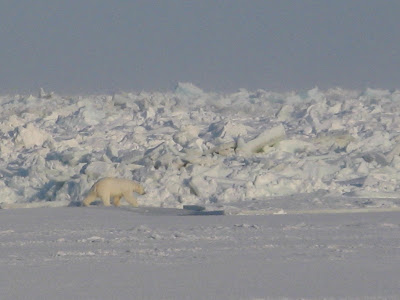
Sometimes when you go out on the ice, you get to see the wildlife. Like polar bears! These shots were taken last week by Tom Douglas, during a sampling trip on the Arctic Ocean a few miles offshore from Barrow.

See him there in the distance, at the foot of the rubble ice?

A zoom in of the bear ...

Saturday, March 21, 2009

Flowers in Barrow ... Frost flowers that is ...

It's another weekend here in Barrow, which for us doesn't mean much ... we still work on the weekend like we would any other day. Alexis is busy processing her most recent snow sample. Actually, in this case, the sample isn't snow, but something called frost flowers.


Frost flowers grow on the surface of newly formed sea ice and are very highly saline (i.e. salty). Previous measurements have shown that as these frost flowers form they can scavenge things from the atmosphere, like mercury. So we'd like to know if they can scavenge organic pollutants, like the pesticides and industrial chemicals we are measuring here. If frost flowers are good at scavenging these pollutants we expect to see very high concentrations of the chemicals, compared to other "normal" snow samples we have taken here. So Alexis went out on the sea ice (over the Arctic Ocean) yesterday and sampled four buckets of frost flowers ...

Here is Alexis (blue parka in foreground) getting ready to sample

A closer view of the frost flowers:


An up-close view, showing the structural detail of the crystals:


Today I'm dealing with more mundane tasks, like keeping our GC (gas chromatograph, shown below) happy. I did some routine maintenance today and am re-calibrating the instrument (something I do pretty routinely ... once per week or so). To make sure everything is accurate, this meant remaking the calibration standards, too. Way too tedious for my taste, but something that has to be done ... oh, the life of an analytical chemist.


Since Tuesday I've been monitoring our PCB photochemistry experiment. PCBs are industrial chemicals that are not currently produced in the US (most countries banned production in the 1970s and 1980s), but are found almost everywhere in the environment. They are found in wildlife here in the Arctic, sometimes in very high concentrations, which is a concern. We'd like to understand if there is any chemistry occuring in snow and ice that might affect PCBs and how they cycle around here in the Arctic.

Every day I go out around 1 pm and sample 36 different vials containing different PCB molecules (6 different experiments, 3 "cooked" vials and 3 "dark" vials for each). The "cooked" vials are the ones that have been sitting out on the snow exposed to sunlight and the "dark" vials are control samples that were kept dark, wrapped in foil, in a box buried in the snow. Analyzing these will help us know how much chemistry is caused by sunlight and how much (if any) happens when the sample is not in the sun. Working up 36 samples for GC analysis takes about 2-3 hours ... then another 12-14 hours of analysis time on the instrument. Luckily, our instrument has an autosampler, which means no one has to be around for the 12-14 hours of instrument analysis time ... it does it all by itself! However, once the samples are analyzed, it's another couple hours of work to make sense of the numbers the instrument produces ... (I guess if the instrument did EVERYTHING I'd be out of job, huh?)

Right now, it looks like the two PCB compounds I'm studying are VERY slowly degrading. The degradation is so slow that I've now decided to only go out every OTHER day to sample.

Soon I'll be starting another experiment, with a different compound ... but I'll save the sordid details of that for a later posting ... :)


Oh, and one more thing: Today Villanova's basketball team made it to the Sweet Sixteen. Go NOVA!