Monday, April 14, 2008

Dr. Bill's Quick Update


Well, I’ve been here in beautiful Barrow, Alaska for a week now. I wasn’t out of the airport, in the cold, for more than 5 minutes before I decided to grow a beard! It can be so very cold. The clothing that the Barrow Arctic Science Consortium lent to me is fantastic. I wore it “snowmachining” on a morning when it was minus 22 degrees and didn’t even notice the cold (too much). Last night, I went out to help a Villanova team member gather samples. I wore my Pennsylvania ready winter clothes and froze!


We begin our webcasts to Bristol High School 3rd period on Tuesday. Our guest will be Mr. Lewis Brower, a member of the local Inupiaq community. He will speak on local history and culture. On Wednesday, I will host a webcast discussion of the status of Bristol High School’s iron study. On Thursday, the Villanova group, an extraordinary band of young scientists, has agreed to webcast a discussion of their projects dealing with the photochemistry of pesticides in the Arctic snow.

Saturday, April 12, 2008

Barrow Health Care

Yesterday I was able to experience first hand the Barrow health care system. It seems while innocently chewing on some snack mix I managed to crack a tooth. Cracked teeth are no fun when you routinely breath in -20 degree air ... it sends quite the pain through your head when that happens! It also makes eating slightly difficult.

So, I made an emergency appointment at the dental clinic, which is located in the Samuel Simmonds hospital in town. They were able to get me in right away and I was treated by a terrific dentist, who shares my name (well, at least the first one)! Amanda Gaynor. She took an x-ray to determine if the crack extended to the root (luckily it did not). She felt the best course of action was just to fill it back in, but warned I might need a root canal once I get back home. Joy!

She blew some high pressure air in the crack and asked me how bad it hurt. A little ouchy, but not too bad ... so she gave me the option of doing it without novocaine. I said, "sure, why not, I'd rather not have a numb chipmunk face for the rest of the day". She had it ready in case things got too painful ... but I made it through and about 20 minutes later had my tooth back in normal condition.

The longest part of the hospital visit was waiting 40 minutes at the pharmacy to get my prescription (some antibiotics). (Mental note: don't go to the pharmacy on Friday when everyone else is getting their meds before the pharmacy closes for the weekend!). Oh, and Ian deserves a medal for waiting in the truck for an hour and a half while I had all this work done. Thanks Ian!

So all in all, it wasn't a bad experience ... I'm just glad I'm working somewhere that a cracked tooth can be fixed on site!

Cheers,
-Amanda

Monday, April 7, 2008

Joy of Spring Festival (Piuraagiaqta)

This weekend in Barrow (April 4th - 7th) the community ushered in the Spring season with the annual Piuraagiaqta celebration. Activities ranged from Maklak racing to a chili cook-off. On Saturday we had the opportunity to participate in the parade as representatives of BASC, also known as the "Barrow Arctic Surf Club." We revived a float from last year's 4th of July parade and retrofitted it for the bed of a Ford F250. The pieces of the float were found under 2 feet of snow by the warehouse and had to be painstakingly excavated by hand (see photo below).


Assembly took place in 3 hours the night before the parade, requiring the use of any scrap lumber we could get our hands on and the tools we could find at 11pm. The assembled float was kept in a secure location until morning so as not to ruin the surprise. The morning of the parade we gingerly drove the giant wind sail of a float the 3 miles to City Hall where we were to assemble for the start of the parade.


The parade traveled from City Hall down the block to Arctic Pizza. We went past the Wells Fargo Bank, heading along the coast towards the post office, ending at the Inupiat Heritage Center. Overall the parade lasted about 45 minutes and we managed to throw six 5 gallon buckets of candy, about 250 packs of Rice Crispy treats and 250 packs of cookies to the excited kids (and adults) lining the parade route. All along the way, we blasted Beach Boys music (appropriate for our "surfing" themed float). None of us want to hear the Beach Boys for a while now.


We also were able to make a new friend along the way. Deanna is a postdoc working at the University of Alaska (Fairbanks) and is working at BASC for only a week or two. She's here by herself and so we "adopted" her and had a great time with her during the parade. (She has one heck of an arm for throwing candy!). She is in the white parka in the photo below.


Thursday, April 3, 2008

PPB Revisited

Out on the Trail

The past few days have been filled with the repeated calibration of our air samplers.  I have had some trouble getting them to operate correctly in the cold and the best advice we got from the manufacturer was to "put a light-bulb in it" for some warmth.  Anyway, more on that later.  

Today I suddenly found myself in dire need of calibration data from one of the air samplers which was soo conveniently located 7 miles into the tundra , and only accessible by snow machine.  I got my tools together, radioed in for a snow machine, and was on my way by 4:30 pm.  About half-way to the control shed where the air sampler was located I started to notice a decrease in the visibility of the trail I had to follow.  I made a good decision and turned back (especially due to the ever present danger of polar bears and this being my first unescorted journey).  Now I was never in any danger, I mean I'm not that stupid to mess with polar bears or the vast expanse of the tundra.  Below is a clip of my trip back to BASC.  What you can't see in this video (and neither could I!) are the wind blown mounds of snow which snuck up on me and tried to throw me off the snow machine.


Later in the day we had some real snowfall and it was time to collect some fresh samples.  The wind wasn't too strong but it was snowing hard enough that there was a complete "white-out".  From a first-hand experience there is nothing in nature that is more confusing and disorienting than the horizon disappearing.  All I could see was white, there was nothing for me to focus on... until I heard something.  All it took was a simple "uh, guys...?" and we found ourselves trying to keep up with our own legs which were leading us to the nearest shelter.  You see when you mix not being able to see a great distance with the largest terrestrial carnivore on the planet you become a bit skittish, but not without good reason.  We were only about 50 yards from the lab and most likely in no danger but it is good to be safe!

Obviously our flight response was in full gear.


In the foreground is one of our sampling buckets, just past that is a small ridge which drops about 10 feet to our sampling site.  Can you imagine what it would look like to see 3 scientists, all decked out in white, scurrying up that?  Notice the lack of horizon.


Fooled by a PPB! (Potential Polar Bear).  Rifle training starts tomorrow...

-Ian

Sunday, March 30, 2008

Northern Lights

Over the past few nights we have been able to witness some spectacular Northern Lights. These atmospheric phenomena are also called the Aurora Borealis - a term coined by Galileo after Aurora, the goddess of morning. (If you were in the southern hemisphere, you'd call them the Aurora Australis). Ian managed to get some photos, shown here.

In this photo above, the blurry figure in the foreground is Ian. (The setting needed to capture the aurora leads to blurring of the foreground). This was just to prove that these are indeed the actual observed northern lights and not just something we googled for images. Behind Ian you can still see a bit of the twilight from sunset ... this view is looking north - the Arctic Ocean "beach" is in the background.

Our first indications of an active night would come around 11 pm - just when the last light of the evening twilight would diminish enough to give us a darkened sky. Whispy trails of greenish-colored "clouds" would appear and move and shimmer, moving generally from north to south. As they became more intense, they'd move quite rapidly and other colors of purples, pinks and blues would appear as well. This would generally keep up for a couple hours - and of course we stayed up for the whole show. At one point we decided to put down the tailgate of our truck and laid in the back to get a more comfy position for viewing.


It really is no wonder that there are mystical tales associated with the Northern Lights. There have been (and still are) many different beliefs about the aurora and their association with the spirit world. For example, the Algonquin believed the lights to be their ancestors dancing around a ceremonial fire. A less spiritual interpretation came from prospectors during the Klondike Gold Rush - the lights were supposedly the reflection of the mother lode of all gold. (For a great description of some of the aurora history - see the wikipedia.org entry for aurora).

But what causes the aurora? The sun sends a constant stream of charged particles toward Earth. Some of these interact with the outer portions of our atmosphere ... the energy from this interaction gets transferred to oxygen and nitrogen present in the atmosphere (about 100 km above the surface of Earth). This excites the oxygen and nitrogen ... but the oxygen and nitrogen don't stay excited forever ... and to get rid of this excess energy, they emit characteristic wavelengths of light, which then are viewed from below as the aurora. (Again, wikipedia gives a good - albeit very detailed - description if you want the real hard-core details).

Whatever the cause, they are a spectacular sight.

Thursday, March 27, 2008

Breaking Trail

Editor's Note: The following occurred on Wednesday, March 26, 2008.

One of our sampling goals while we are in Barrow is to collect sea ice, snow and open water from the Arctic Ocean. When we heard that the BASC station manager (Lewis Brower) was heading out to the ice to break trail as part of the ABC whaling crew, we asked if he would be so kind as to collect some samples for us. However, Lewis gave us an even greater opportunity - he asked if we wanted to come along out with him and get the samples ourselves. We of course jumped at the chance. The only condition was that we'd help break trail toward the open water. A fair exchange in our view!


Each of the whaling crews at Barrow must break their way through the rough ice that is present near the coastline to get out to the open water where whales will surface to breathe. It is imperative for a successful hunt that a passable trail is made from the coast all the way out to the open lead, as this is how the crew's supplies, boats, snowmachines, etc will be taken to the whaling camp. (The open water is about 5 - 5.5 snowmachine trail miles out). Each crew makes their own individual trail and it is not easy work. As you can see from the photo above, the surface is extremely rough and the large chunks of ice must be broken down enough to allow passage of snowmachines with sleds in tow. This labor is all done by hand with ice picks and the trails are smoothed out further by running snowmachines back and forth along the trail. We were warned that it is very easy to flip a snowmachine under these conditions and to be careful and take things slow and easy. We also had to keep an eye out for polar bears, although none came our way on this particular day.

After a slow trek to the farthest point of the ABC crew's trail, Lewis stopped to assess where we should go next. Lewis made a careful scan of the ice conditions ahead (this must be done by someone who knows how to read the ice and can predict where the best trail will be). He then instructed us on how to proceed, taking the time to explain to us "newbies" why he wanted to go a particular way - so it was a great learning experience for us.


We were out on the ice for just under an hour when Lewis' father, Arnold Brower, came out to the ice. At nearly 90 years old, he is the oldest whaling crew captain in Barrow. (ABC stands for "Arnold Brower's Crew"). We were amazed at how easily he made his way across the snow and ice - certainly moving faster than Ian, Glenn or I could. As we made our way farther out to the open water, Arnold and Lewis continued to climb to high points to scout out the best trail ...


We continued to make slow but steady progress ... but the open water is still about 3 miles out ... so there is a lot of work left before the crew will get to their final destination where they can set up camp near the open water.

However, it wasn't all work and no play. Often we were able to stop and talk with Lewis and Arnold about everything from whaling to their trips to the lower 48. We were thrilled to be able to hear Arnold's stories of whaling and hunting (he also has a hunting camp about 85 miles away that he regularly travels to), how one can ferment whale (it ferments "like berries" in Arnold's words) and how he makes reindeer jerky. It was also eye-opening to hear his first hand account of how he has lost portions of his food stores because the underground ice cellars are becoming too warm (due perhaps to the changing permafrost from warmer ground temperatures). Holes are dug into the permafrost which can then serve as natural freezers ... unfortunately, as the permafrost warms, it threatens the integrity of the stored food, as it can begin to grow bacteria and eventually will spoil all together.


After about three hours we stopped to enjoy the finer things in life - a hot cup of tea on the Arctic Ocean. Lewis graciously shared his thermos of tea with us and it certainly hit the spot. We then headed back to BASC, just in time to catch dinner ... and reflecting on the day's events, Ian, Glenn and I all agreed that our time on the ice was the most interesting, exciting, humbling, and awe-inspiring experience we have had.

Snow Day

Today we took a snowmachine ride to the Barrow Environmental Observatory (BEO) to sample snow. The BEO is an area of land over 7,400 acres in size permanently set aside for Arctic research experiments. The land belongs to the UIC (Ukpeagvik Inupiat Corporation) and they have set aside this land specifically for scientific research. The existence of the BEO is a testament to the commitment of the North Slope residents to the advancement of science and to collaboration between local people and scientists. BASC has been designated to manage the operations at the BEO and the National Science Foundation also has a cooperative agreement with BASC to support management of the BEO. The North Slope Borough (northern Alaska's regional government) also supports the BEO. In short, it is a great place to conduct research, as there is an existing infrastructure that makes the life of a scientist much easier than just tromping off into the tundra un-aided (or un-invited).


You can see from the photos, we try to take precautions not to accidently contaminate our samples. We wear Tyvek full-body suits that slip over our clothes/coats/parkas. We wear nitrile gloves. We also walk a ways upwind of our snowmachines. Our sampling scoops/shovels have been washed throughly and are transported to the site wrapped in foil and then plastic. We look rather funny out there on the tundra with our "bunny suits", but it's all for a good cause.


And now for the science!:

The snow we sampled will be used for several purposes. First, we will be extracting organic polltuants from the samples. We will melt the snow and pass it through a glass column that contains small particles of an organic resin called XAD. The pollutants should "stick" to the resin and the water will pass through. We'll then package up the XAD resin and ship it back to Villanova where we'll extract it and analyze what comes off to identify and quantify what was in the snow. We're looking for things like pesticides, PCBs, etc. The reason we don't do the extraction here is because it takes a rather large volume of solvent, and we don't want to generate a lot of chemical waste while we are here in Barrow.


We'll also take a small volume of melted snow (about 300 milliliters) and do a different kind of extraction - this one is using "stir bar sorptive extraction". Basically, we have a small magnetic stir bar that is coated with an organic polymer called polydimethyl siloxane (PDMS). The sample sits on a magnetic stirring plate and the stir bar agitates the sample for several days. Again, the assumption is that the pollutants will stick to the PDMS on the stir bar. We'll then extract the stir bar using a very small volume of hexane and Ian will be able to analyze that on the GC that we have on-site here. We can do this analysis on site because it generates virtually no chemical waste.


Finally, Glenn and I will be using some of the snow to make solutions that contain known amounts of pollutants. (Very small quantities - the concentrations are a few micrograms of pollutant per liter of water). We're going to seal these solutions in glass containers (small little vials called "ampules") and set them outside in the snow and let them "cook" in the sunlight. We think that some of the pollutants are going to degrade when left to "cook". Over the course of many hours we will monitor the concentration of the pollutant (since we know what we put in at the start, we can see how much of it degrades, or goes away). If it goes away fast, then it means that photochemistry (that is, chemistry driven by sunlight) is a potentially important way the pollutant degrades in this environment. If it goes away slowly (or not at all) then it means that photochemistry isn't so important.


We want to know about all of this, because ultimately these pollutants will end up getting into surrounding soils, streams, lakes and the ocean when the snow melts. The local indigenous population relies heavily on wildlife from the area as a food source and unfortunately, these pollutants are showing up in the fish and whales and seals and other wildlife they consume. We want to better understand HOW the pollutants are getting to their ultimate destinations and how the pollutants might change while they are sitting in snow and ice, waiting for snowmelt to transport them elsewhere.


So that is a description of our goals for this particular set of samples. We'll be going out a lot more to sample ... and you'll see those trips on here as well.

Tuesday, March 25, 2008

The Great Arctic Peep Experiment

Editor's Note: This set of experimentation was commenced only after completing the initial installation of our air sampler on the roof of BARC as well as various other lab preparation tasks needed for us to do our "REAL" science. The GAPE 2008 experiment was our way to blow off some steam and have some fun on a Sunday holiday. So yes, mom, we ARE doing work too! :-)

On Sunday, March 23, 2008 we celebrated Easter with a great scientific endeavor. We call this the Great Arctic Peep Experiment 2008 (or G.A.P.E. 2008 for short).


Long assumed to be a species found only in temperate climates, it has come to our attention that a hearty breed of Peeps makes its home in the Arctic. We discovered two varieties - yellow and pink. We hypothesize that the color differences may in fact distinguish the male and female of the species, but because we have no knowledge of how to sex a Peep, this will have to remain conjecture.


Our first experiment involved the observation of the Peep in its native climate. A Peep was found resting in a snowbank and was observed from an appropriately safe and non-interfering distance to document its behavior. After a prolonged exposure to the elements, no adverse effects were observed. The photo shows a pink Peep after 3 hours in its snowy resting place at -15F.

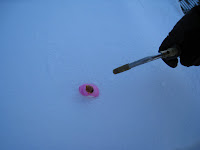


Given the evolution of the Arctic Peep and its adaptation to survive in extreme cold, it was necessary to also test Peep response to heat. It was hypothesized that the Arctic Peep would be quite susceptible to heat. This hypothesis was tested by exposure of the Peep to a propane torch, as seen at left.


We observed an extreme adverse reaction of the Arctic Peep to heat. It seems that the adaptation the Peep evolved to survive the long, cold Arctic winter has left it vulnerable to heat. This response is evidenced in the photo at left, showing the charred and melted Peep after only a short exposure to the heat source.


Unfortunately, this experiment was not able to be performed in triplicate, for obvious reasons.

It is known that certain materials (e.g. one's tongue) will stick to cold metal surfaces (e.g. a flagpole in winter) with surprising adhesive strength. We tested this by placing a Peep on a metal railing. The Peep did not stick to a metal surface at ambient temperature. We hypothesized that this was due to the relatively dry exoskeleton (i.e. sugar coating) of the Peep, and that a moist Peep would have much greater adhesive properties.


After moistening the Peep with water, the Peep did indeed adhere itself to a metal surface, with surprising strength.


Unfortunately, before we were able to free the Peep, a known Peep predator took advantage of its immobile state and consumed the Peep before we were able to render any assistance.


Our next experiment was to test the adrenal system of the Peep and its "Fight or Flight" response to an obvious threat. Anecdotal evidence of previous researchers indicated that Peeps were rather passive and often were observed allowing obvious predators to devour them with no apparent struggle. We exposed several Peeps to three threats - a mallet, a hand axe and a pick axe. Both yellow and pink Peeps were exposed to the threats. The photo at left shows our "Peep Cam" and the view the Peep had of the approaching "predator" armed with the hand axe.


The first Peep was of the pink variety and was threated with a hand axe. The Peep ran from the impending downward swing of the axe. The photo at left shows that the axe completely missed the Peep due to its hasty getaway.


The Peep quickly escaped to the base of a nearby snow pile (as seen at left from the "Peep Cam").


It climbed this snowpile with surprising agility and made an escape to an inaccessable height, far out of the reach of the threatening hand axe. The "Flight" response certainly saved this Peep from its untimely demise.


The yellow Peeps, on the other hand, did not show any Fight or Flight response. They allowed themselves to be smashed and chopped to bits with no apparent effort to run or defend themselves.


The final experiment was called the "Peep Drop". A pink Peep and a yellow Peep were dropped from the top of the BARC building (a height of approximately 38 feet) to observe if Peeps would reach terminal velocity and if one type of Peep dropped more quickly or landed with greater impact than another. Both Peeps traveled with the same velocity and both felt the pull of Earth's gravity equally. Photos of the Peeps, post-plummet, are shown below. Both Peeps emerged from the drop apparently unscathed, although the yellow Peep complained of a slight headache after the experiment. It was given a Tylenol and recovered soon thereafter.


In conclusion, our analysis of the notorious Arctic Peep has broadened our knowledge of a rare species. The efforts of the research team shed new light on their habitat and behavior and open the door to myriad future studies.
Sunday, March 23, 2008