Friday, April 17, 2009

Heading Home

Well, after a lot of work (and some fun mixed in there too), it is time to leave Barrow and head home to the lower 48. As I write this blog entry, I'm sitting in the Anchorage airport, enjoying the free wireless internet, waiting for my taxi south. (A BIG taxi with wings and a jet engine).


Barrow will certainly be missed, and I look forward to a return trip in late May/June ... we will continue our sampling campaign during the Barrow snowmelt period. Although I'm always happy to return to Barrow ... its people and culture have seemed to really touch my heart ... there are a few things I will be happy to see and experience again down south. I'll make a list of those later though ... right now I think I need a pre-flight nap. ***Yawn***

Thursday, April 9, 2009

It's Snowing!

You may wonder why the fact that it is snowing makes for a special blog post. Isn't it snowing all the time in Barrow?

Actually, the answer to that is a resounding NO. Barrow can actually be considered a desert climate, in terms of precipitation amounts. On average, Barrow receives less than 30" of snow (an equivalent of less than 5" of water). The USGS defines arid lands as those that receive less than 250 millimeters of annual rainfall (or 10" equivalent water). By comparison Buffalo, N.Y., receives an average of 80” to 100” of snow alone per year.


However, across Alaska, the amount of snowfall can be extremely varied. Southern Alaska receives far greater amounts of snow than the north. For example, Thompson Pass, a popular extreme ski and snowboard area north of Valdez, once received a record 974.5” of snow during the winter of 1952-1953 and in one 24 hour period in December 1955 the same area recorded a 62" snowfall.

The deepest recorded snow pack in all of North America occurred at Wolverine Glacier on the Kenai Peninsula during the winter of 1976-1977. The depth was 356”. Almost 30 feet deep!

By comparison, Barrow, in the dry north, received a record minimum amount of snow during the winter of 1935-1936 of only 3”.

Saturday, April 4, 2009

Schoolyard Saturday

The past few days have certainly been busy ones. A lot of snow sampling has been going on ... a group of us are doing a 36 hour experiment to monitor the changes in snow composition as a function of sunlight. Several of my colleagues have been sampling the snow every two hours since Friday morning. Unfortunately, because of the large volume of snow that I need for a sample (and the time it takes to process those amounts of snow), I was only able to sample three times. Once at the start, middle and end of the experiment. For our work, one sample requires gathering two 5-gallon buckets of snow. This snow then melts overnight and the pollutants are extracted from the snow and sent home for analysis at Villanova. (See our previous "movie" of sampling, posted on March 24). We are interested in how the pollutants migrate within the snowpack, so I sampled from three different layers (or depths) in the snow. Where I am sampling, the total snowpack depth is about 30-40 cm (a bit more than 12 - 16 inches). So, I have to dig up a relatively large area of the snow to fill my buckets. My colleagues just shake their heads when I'm finished, because it looks like an angry herd of buffalo had their way with the snow where I sampled.

In other news, I also gave a talk today to the local community about our work, at an event called "Schoolyard Saturday". Every Saturday someone comes in to talk about their work in the Arctic, or some other interesting topic they find appropriate, and the talk is open to the public. I had pretty good attendance given that I was competing with the local "Spring Festival" being held this weekend in town. The talk lasted about 40 minutes, but was followed by many interesting questions that lasted another 30 minutes or so. Apparently I didn't put anyone to sleep!

So our work here is wrapping up - at least for this trip. Another full week of work and then it will be time to pack up and head back home again. I must admit, it will be good to be able to sleep in my own bed again ... and with springtime in full force in Pennsylvania, I'll get to mow grass too ... oh, if only that were something I actually looked forward to! There is something to be said for living in a place where you don't have grass to mow!

Wednesday, April 1, 2009

Out Like a Lamb???

March came in like a lion, and has gone out like a lamb.


Well, perhaps lamb is not quite the right term. Today it was VERY windy (20 mph sustained) and cold (-20F). Wind chills were below -40F.


So maybe March went out not quite like a lion, but more like a very angry lamb.

Sunday, March 29, 2009

Arctic Scenery

Things are going well here on the tundra. My photochemistry experiments are cooking away in the bright, bright sunlight we've been having (see the pic below of me "tending" my experiment). The weather has been nothing but sun (and a little wind here and there) for almost two weeks now. I'm just waiting for the next blizzard to blow in, because it certainly can't stay this nice for much longer! The only bad thing that I have to report is that a fox peed on my radiometer the other day! The nerve!!! :)

I've made it out a couple times this week to do snow sampling. Usually this is a task that belongs to Alexis ... but she took a short hiatus from the field to travel to Boston for the NCAA basketball tournament. She must have been a good luck charm, because not only did Nova win the Sweet 16 game, but they also won the Elite 8 game against #1 Pitt. Now we're on to the Final Four!!! Alas, Alexis will be back in Barrow when that game is played, so she'll have to suffer through watching it on TV instead. Oh the trials and tribulations of a grad student. ;)

Meanwhile, I've put together photos taken during our 2008 and 2009 fieldwork ... check out the video below. You will notice at the end a dedication to Arnold Brower, Sr. Arnold was a highly regarded elder in the Barrow community here and was the oldest active whaling captain (86 years old) here as far as I understand. We got to meet him last year and talk with him about his hunting activities, his involvement in the community, his thoughts on climate change, etc. He was a fascinating man. Very sadly, he died last fall while out on a hunting trip. His snowmachine went through thin river ice and, although he was able to get out, he wasn't able to make it to shelter in time, and passed away. It was a great loss to the Barrow community. He was a great man and I feel very privileged to have had a chance (if just for a short time) to get to hear some of his stories. His son, Lewis Brower, is actually the station manager here at the Barrow Arctic Science Consortium (the organization that handles the logistics of those doing fieldwork here in Barrow).


Friday, March 27, 2009

Blogging for the Discovery Channel

Well, it seems we've made it big now ... I've been asked to blog for the Discovery Channel about the life and times of a researcher in the Arctic! Check out the link below to the blog site for our field campaign.


http://blogs.discovery.com/earth_live_oasis/


A lot of the entries are pretty similar to the ones you'll see here. But with information on multiple blogs (also check out the OASIS blog link, at right), perhaps we can better reach the masses with our harrowing tales of braving the elements and fighting off polar bears in the name of science.

Okay, yes, I realize that last bit was a HUGE exaggeration ... but didn't it sound exciting!?!

Thursday, March 26, 2009

Out on the Sea Ice

Last night I had the opportunity to go out on the sea ice with a group of researchers from Environment Canada. They have some instrumentation set up at the edge of a refrozen lead, measuring things like mercury and halogens, which relate to ground level ozone depletion events being studied during this OASIS field campaign (all very fascinating to the atmopsheric chemistry type like me). In case you are wondering, a lead is an area of the sea ice that opens up to expose the water ... these are certainly not permanent and can close up, refreeze, or get bigger depending on the winds and ocean currents. This trip to the ice was mainly to check on the status of the instruments and to do some snow sampling.

The trip out is done on a snowmachine (snowmobile to those of you down south, or ski-doo to you Canadians) over a pretty bumpy trail that was "hand carved" through the ice with ice axes. You may envision the frozen ocean as a nice flat sheet of ice, but in fact it is quite the opposite. As the sheets of ice move and bump into each other, big piles of ice form, several stories tall in some places. It really is quite a sight. Here are a few pics:

A gorgeous sunset on the Arctic Ocean ...

A view of the "rubble ice", caused by ice sheets driving in to each other, raising up the ice in big chunks, some the size of a tractor trailer ...

Me (on left) helping Sandy Steffen (Environment Canada) sample frost flowers. This was how I justified my presence on the trip. :) This flat area of ice where we are at is a refrozen lead. The ice here is about 40 cm thick, or about 16 inches thick. It doesn't sound like a lot, but 16 inches of ice can hold a LOT of weight (you could pretty safely drive a tractor trailer over ice just a few inches thick).

Me about halfway up the climb on the rubble ice ...


As I write this blog entry, the Environment Canada team is racing out to their site to bring in their equipment. The winds are shifting and the area we were at last night will probably be a new pile of rubble ice soon, or may break off entirely from the ice closer to land and drift away ... the ice sheets are moving and it would not be in the best interest of the equipment to leave it out there to either be crushed, or fall in the ocean.

Tuesday, March 24, 2009

Our Box Office Hit

Watch below for a glimpse of what is sure to be a box office sensation! This movie provides excitement, danger, thrills and chills at -40F.

"Stunning" says People Magazine

"Two thumbs up" raves Entertainment Weekly

"Action, intrigue and pure entertainment. This movie just keeps you wanting more" mumbles Rolling Stone


Monday, March 23, 2009

Bear with me ...

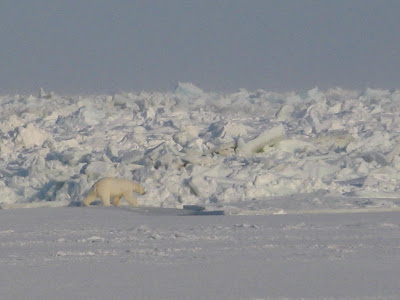
Sometimes when you go out on the ice, you get to see the wildlife. Like polar bears! These shots were taken last week by Tom Douglas, during a sampling trip on the Arctic Ocean a few miles offshore from Barrow.

See him there in the distance, at the foot of the rubble ice?

A zoom in of the bear ...

Saturday, March 21, 2009

Flowers in Barrow ... Frost flowers that is ...

It's another weekend here in Barrow, which for us doesn't mean much ... we still work on the weekend like we would any other day. Alexis is busy processing her most recent snow sample. Actually, in this case, the sample isn't snow, but something called frost flowers.


Frost flowers grow on the surface of newly formed sea ice and are very highly saline (i.e. salty). Previous measurements have shown that as these frost flowers form they can scavenge things from the atmosphere, like mercury. So we'd like to know if they can scavenge organic pollutants, like the pesticides and industrial chemicals we are measuring here. If frost flowers are good at scavenging these pollutants we expect to see very high concentrations of the chemicals, compared to other "normal" snow samples we have taken here. So Alexis went out on the sea ice (over the Arctic Ocean) yesterday and sampled four buckets of frost flowers ...

Here is Alexis (blue parka in foreground) getting ready to sample

A closer view of the frost flowers:


An up-close view, showing the structural detail of the crystals:


Today I'm dealing with more mundane tasks, like keeping our GC (gas chromatograph, shown below) happy. I did some routine maintenance today and am re-calibrating the instrument (something I do pretty routinely ... once per week or so). To make sure everything is accurate, this meant remaking the calibration standards, too. Way too tedious for my taste, but something that has to be done ... oh, the life of an analytical chemist.


Since Tuesday I've been monitoring our PCB photochemistry experiment. PCBs are industrial chemicals that are not currently produced in the US (most countries banned production in the 1970s and 1980s), but are found almost everywhere in the environment. They are found in wildlife here in the Arctic, sometimes in very high concentrations, which is a concern. We'd like to understand if there is any chemistry occuring in snow and ice that might affect PCBs and how they cycle around here in the Arctic.

Every day I go out around 1 pm and sample 36 different vials containing different PCB molecules (6 different experiments, 3 "cooked" vials and 3 "dark" vials for each). The "cooked" vials are the ones that have been sitting out on the snow exposed to sunlight and the "dark" vials are control samples that were kept dark, wrapped in foil, in a box buried in the snow. Analyzing these will help us know how much chemistry is caused by sunlight and how much (if any) happens when the sample is not in the sun. Working up 36 samples for GC analysis takes about 2-3 hours ... then another 12-14 hours of analysis time on the instrument. Luckily, our instrument has an autosampler, which means no one has to be around for the 12-14 hours of instrument analysis time ... it does it all by itself! However, once the samples are analyzed, it's another couple hours of work to make sense of the numbers the instrument produces ... (I guess if the instrument did EVERYTHING I'd be out of job, huh?)

Right now, it looks like the two PCB compounds I'm studying are VERY slowly degrading. The degradation is so slow that I've now decided to only go out every OTHER day to sample.

Soon I'll be starting another experiment, with a different compound ... but I'll save the sordid details of that for a later posting ... :)


Oh, and one more thing: Today Villanova's basketball team made it to the Sweet Sixteen. Go NOVA!